 timothy
539fcde902
The six SPA screens that hand-build write-request objects field-by-field could
silently drop a DTO field on a full-replace write — #754's mechanism narrowed to
optional fields, filed as residue by `testing.full-replace-asserts-field-list`.

The premise that residue was filed on turned out to be wrong, and the correction
is the more useful half. The mechanism was LATENT, not live: the OpenAPI type
generator renders a nullable DTO property as a required member of a nullable type
(`"name": null | string`), not as an optional one, and none of the eleven request
schemas these builders target declares a single `?:` member. tsc was already
checking all of them. But it was doing so contingently — on a generator behaviour
nothing asserts, for a set of DTOs none of which had yet acquired an optional
property. Optional members already occur elsewhere in the same generated file, so
the contingency was one modelling decision away from lapsing silently.

`Complete<T>` removes the contingency rather than asserting the generator's
current behaviour: it maps a request type so every member is required, making an
omission a hard error however the generator emitted it. Applied at the
full-replace wrapper boundary so future callers inherit it without knowing it
exists, and at each construction site, which is what keeps the excess-property
(phantom-field) direction alive — two sites had lost it by building through an
inferred local or a spread rather than a fresh annotated literal.

Measured, not argued: injecting an optional member into `ScheduleItemRequest`
reddens `normalizeForSave` with TS2741 under `Complete<T>` and compiles CLEAN
without it. Mutating `Complete<T>` to drop `Required` reddens the guard's case 2;
`Partial<T>` reddens cases 2 and 4. Case 4 does not discriminate against the
realistic mutation and the guard says so, because no real request type can today
— which is the contingency itself.

The proof ships as `@ts-expect-error` cases re-executed on every `npm run
typecheck` (a marked CI step), not witnessed once by hand.

Verification: typecheck clean, eslint clean, 1200 web tests pass (new guard test
confirmed executed by name), 833 scripts/tests pass.

fixes #807

Decisions-Edit: yes
ErsatzTV
ErsatzTV lets you transform your media library into a personalized, live TV experience - complete with EPG, channel scheduling, and seamless streaming to all your devices. Rediscover your content, your way.


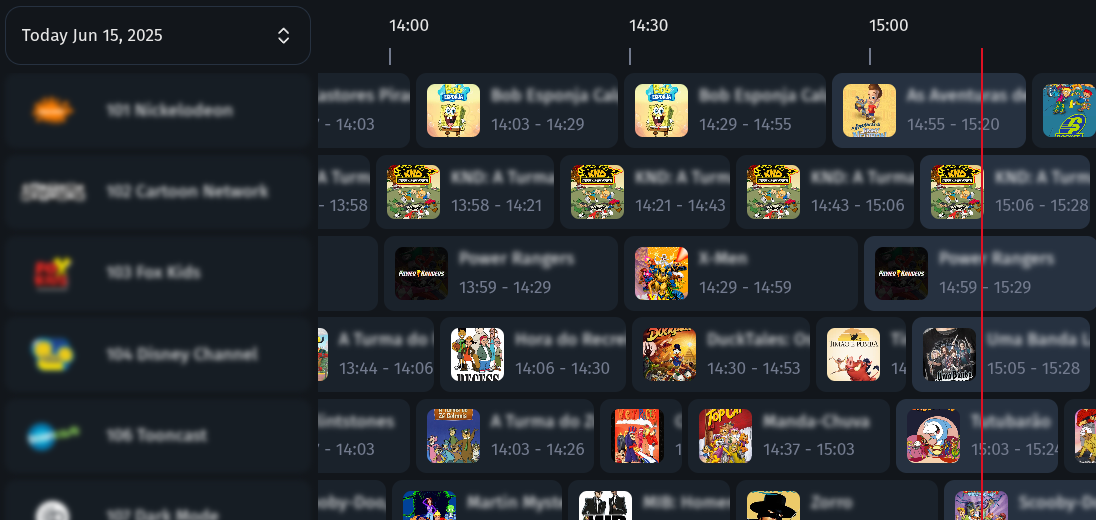
How It Works
- Install ErsatzTV: Download and set up the server on your system.
- Add Your Media: Connect your media libraries and collections.
- Create Channels: Design and schedule your own live channels.
- Stream Anywhere: Watch on any device with IPTV and EPG support.
Key Features
- Custom channels: Create and schedule your own live TV channels.
- IPTV & EPG: Stream with IPTV and Electronic Program Guide support.
- Hardware Transcoding: High-performance streaming with hardware acceleration (NVENC, QSV, VAAPI, AMF, VideoToolbox)
- Media Server Integration: Connect Plex, Jellyfin, Emby and more.
- Music & Subtitles: Mix music videos and enjoy subtitle support.
- Open Source: Free, open, and community-driven project.
Documentation
Documentation is available at ersatztv.org.
License
This project is inspired by pseudotv-plex and the dizquetv fork and is released under the zlib license.