
 timothyandClaude Opus 5
86e9ad41a6
timothyandClaude Opus 5
86e9ad41a6
Round 5 found that §3c and the `rule:` field now instruct readers to gate the DISMISS request, while
`AddItemsDialog` -- the one site this record names as "the shape fixed here" -- called `onClose()`
unguarded, with a comment arguing that was correct. So a reader following the convention wrote the
gate and a reader copying the reference implementation did not.

The defect is pre-existing; the CONTRADICTION is mine, introduced when round 3 withdrew H1's code
but kept the convention it produced. I checked the docs against the withdrawn addTo code and did not
re-check them against the exemplar that stayed.

Measured at this site: submit, Escape mid-request, reopen the picker to retry, first POST returns
204 -> the stale instance's `onClose()` (`() => setPickerOpen(false)`) closes the dialog the user
just reopened, discarding the selection they rebuilt. Identical mechanism to the addTo clobber.

Unlike the addTo layer, the one-line gate IS sufficient here, and that difference is the point:
`AddItemsDialog`'s parent has no competing closer (`onAdded` is `load`, which never touches
`pickerOpen`), whereas `AddToMenu.handleAdded` closes its dialog itself. That is now stated in the
record as the concrete reason one half shipped and the other went to #877.

- `onAdded()` stays unguarded -- it REPORTS, and the parent's list reload must survive dismissal
- `onClose()` is guarded -- it REQUESTS A DISMISSAL, and after dismissal it aims at whatever the
  user opened next
- comment rewritten to say which is which and why, instead of defending both as "belong to the
  still-mounted PARENT"

Pinned, and nothing pinned it before: "a late SUCCESS does not close the dialog the user reopened
after dismissing (#830)". It carries an anti-vacuity check that the late response was actually
processed -- `onAdded` is `load`, so a second GET of the items endpoint must have happened -- because
otherwise "the dialog is still open" holds trivially. Executed: deleting the `if (mountedRef.current)`
around `onClose()` reddens it alone.

Also rewrapped five record body lines left ragged by earlier splices.

1277 tests green, tsc/eslint/build clean, pytest 1228 passed, validator OK, catalog no drift.

refs #830, #877

Co-Authored-By: Claude Opus 5 (1M context) <noreply@anthropic.com>
Claude-Session: https://claude.ai/code/session_01XE2tF2aUasK2hWPmBRsrMY
ErsatzTV
ErsatzTV lets you transform your media library into a personalized, live TV experience - complete with EPG, channel scheduling, and seamless streaming to all your devices. Rediscover your content, your way.



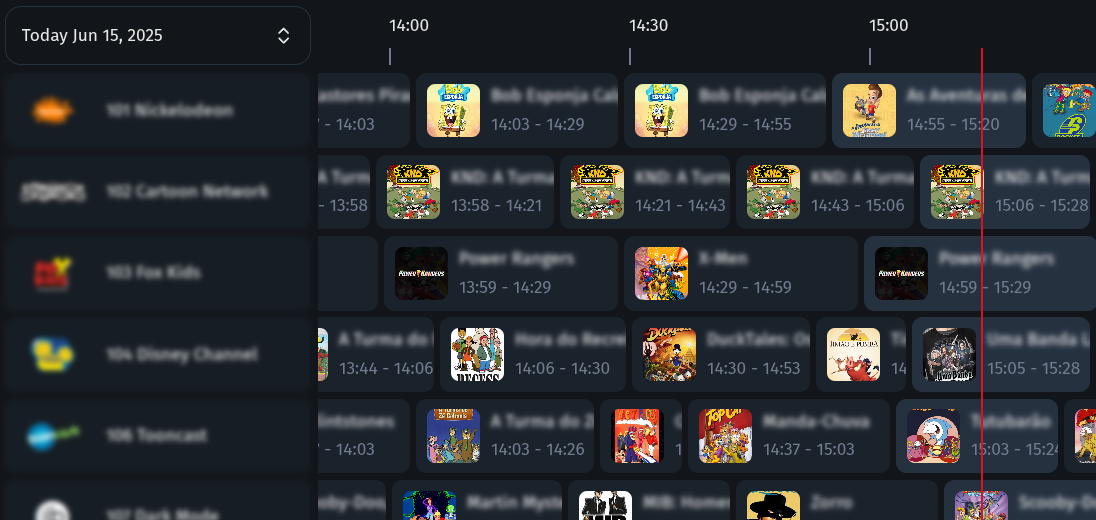
How It Works
- Install ErsatzTV: Download and set up the server on your system.
- Add Your Media: Connect your media libraries and collections.
- Create Channels: Design and schedule your own live channels.
- Stream Anywhere: Watch on any device with IPTV and EPG support.
Key Features
- Custom channels: Create and schedule your own live TV channels.
- IPTV & EPG: Stream with IPTV and Electronic Program Guide support.
- Hardware Transcoding: High-performance streaming with hardware acceleration (NVENC, QSV, VAAPI, AMF, VideoToolbox)
- Media Server Integration: Connect Plex, Jellyfin, Emby and more.
- Music & Subtitles: Mix music videos and enjoy subtitle support.
- Open Source: Free, open, and community-driven project.
Documentation
Documentation is available at ersatztv.org.
License
This project is inspired by pseudotv-plex and the dizquetv fork and is released under the zlib license.