 timothy
d4e112f1e9
timothy
d4e112f1e9
Build ErsatzTV Image / CI image pin matches docker/ci (pull_request) Successful in 15s
Build ErsatzTV Image / Docs update reminder (pull_request) Successful in 13s
Build ErsatzTV Image / decisions.md append-only (pull_request) Successful in 16s
Build ErsatzTV Image / API docs in sync (OpenAPI + endpoint index) (pull_request) Successful in 17s
Build ErsatzTV Image / Formatting (changed .cs conform to .editorconfig) (pull_request) Successful in 20s
Build ErsatzTV Image / Build & test (.NET) (pull_request) Successful in 7m34s
Build ErsatzTV Image / Functional E2E (curl contracts) (pull_request) Successful in 14m15s
Build ErsatzTV Image / EF migration integrity (SQLite + MySql) (pull_request) Successful in 18m39s
Build ErsatzTV Image / Build & push image (amd64) (pull_request) Has been skipped
Second adversarial re-review defeated the product budget too, and the
mechanism generalizes: the budget was enforced on a number the decoder
does not honor.

Measured on ImageSharp 3.1.12 (reproduced independently before fixing):

  600-frame APNG  ->  Identify: FrameMetadataCollection.Count = 0
                      Load:     Frames.Count = 600

So EnsureDecodeAffordable(w, h, 0) charged Math.Max(0,1) = 1 frame —
the most permissive possible reading. A 4000x4000 x600 APNG is ~134 KiB
on the wire, is charged 16 MP, and decodes to ~36 GiB: 2.5x worse than
the GIF the previous commit exists to stop, at half the wire size. The
retention budget could not backstop it — that runs after LoadAsync, so
the process OOMs first, killing every concurrent stream.

GIF, WebP and TIFF report honestly; PNG/APNG is the sole divergence,
which is the point: you cannot audit every format, so the header cannot
be the source of truth.

DecodeRemoteImage now:
- checks header DIMENSIONS only (trustworthy; a GIF image descriptor
  exceeding its logical screen is clamped by the decoder, verified)
- derives how many frames of that size the budget affords
- passes that to DecoderOptions.MaxFrames, which the DECODER enforces
  whatever the header claimed. Measured: MaxFrames = N yields N-1
  frames, so it asks for affordable + 2 — decoding one more than allowed
  is what distinguishes "at the limit" from "over it" without silently
  truncating a legitimate animation
- re-verifies the real image.Frames.Count after decoding, disposing and
  rejecting if over

Also adds wiring coverage for the retention budget (M4): deleting its
call site now fails a test — negative-controlled, build verified before
trusting the result.

docs/decisions.md records both failed attempts, because the lesson is
the generalizable part: independent caps do not compose into a budget,
and a limit the decoder does not enforce is not a limit.
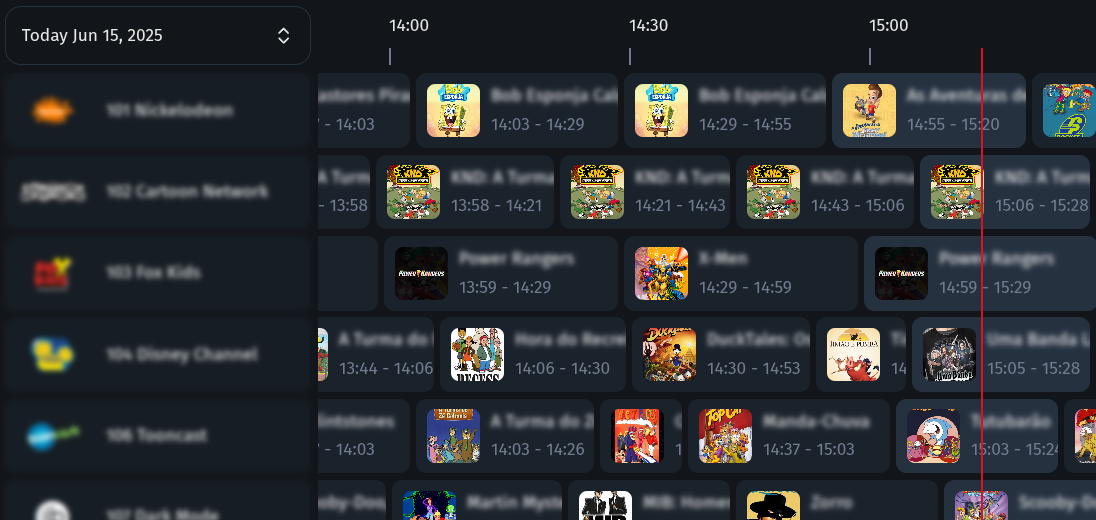
ErsatzTV
ErsatzTV lets you transform your media library into a personalized, live TV experience - complete with EPG, channel scheduling, and seamless streaming to all your devices. Rediscover your content, your way.



How It Works
- Install ErsatzTV: Download and set up the server on your system.
- Add Your Media: Connect your media libraries and collections.
- Create Channels: Design and schedule your own live channels.
- Stream Anywhere: Watch on any device with IPTV and EPG support.
Key Features
- Custom channels: Create and schedule your own live TV channels.
- IPTV & EPG: Stream with IPTV and Electronic Program Guide support.
- Hardware Transcoding: High-performance streaming with hardware acceleration (NVENC, QSV, VAAPI, AMF, VideoToolbox)
- Media Server Integration: Connect Plex, Jellyfin, Emby and more.
- Music & Subtitles: Mix music videos and enjoy subtitle support.
- Open Source: Free, open, and community-driven project.
Documentation
Documentation is available at ersatztv.org.
License
This project is inspired by pseudotv-plex and the dizquetv fork and is released under the zlib license.